Product Design2026● Concept
ClassLog
A self-initiated product concept — the operating system for freelance fitness instructors. I took it from problem research through a full PRD, a design system, and interactive prototypes to a pitch deck, centralising scheduling, billing, and compliance in one tool.
.timeline
Self-initiated concept — 2026
.year
2026
.tools
Figma, Stitch, Claude, Notion, JTBD mapping, competitor analysis
.role
Product Lead
.problem
Problem
Freelance fitness instructors run real businesses on almost no infrastructure — and I used to be one of them. I taught across three to six venues a month — a David Lloyd here, a PureGym there, a boutique studio on the weekend — and every one had its own pay rate, invoice format, PO-number rules and payment date. I came to call it the freelance friction, and it showed up in three places. Scheduling was fragmented across calendars and WhatsApp groups, which quietly caused double-bookings and lost cover work. Billing was manual and dreaded: at month end I'd reconstruct what I'd taught, do the maths by hand, and build a different invoice in a different format for each venue — and, like most instructors, I was hazy on the "self-bill" arrangements I'd actually signed up to. And compliance was a genuine liability: public liability insurance and first-aid certificates expired on dates nobody was tracking, which put both the instructor and the venue at risk. There was no tool built for this specific person — studio platforms served gym managers, PT software served trainers who bill individual clients, and generic invoicing tools didn't understand the venue-as-payer model.

.solution
Solution
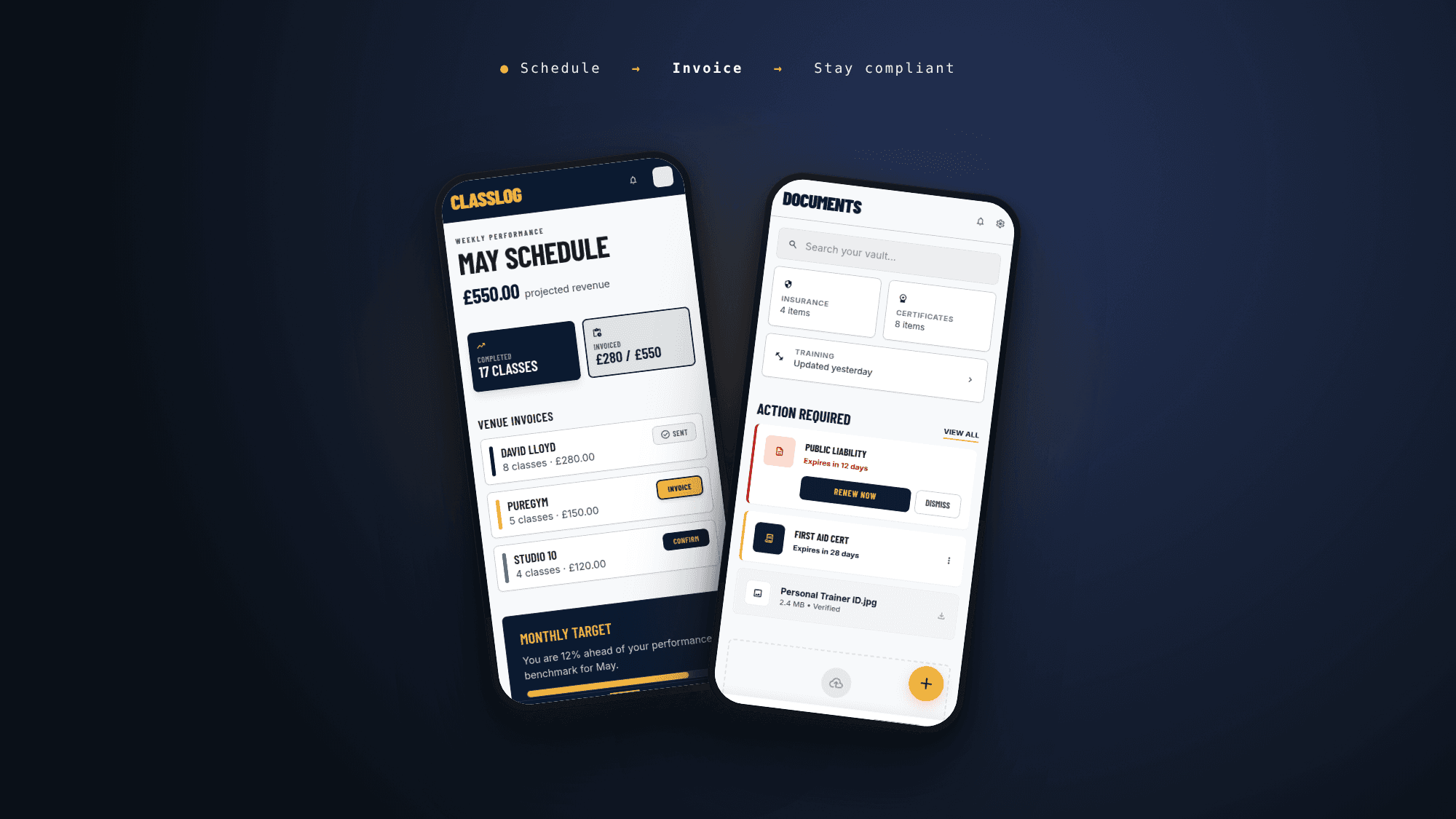
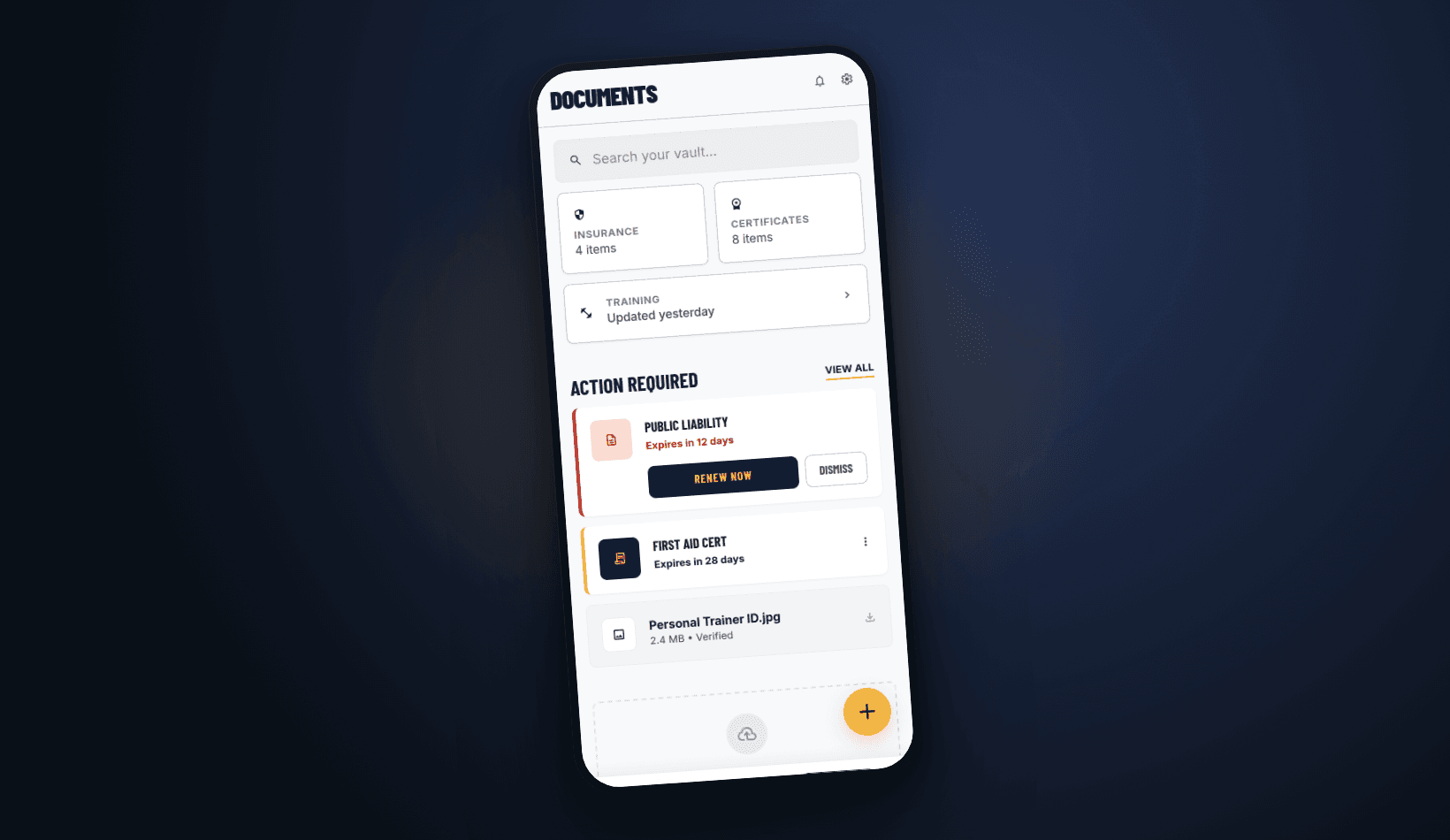
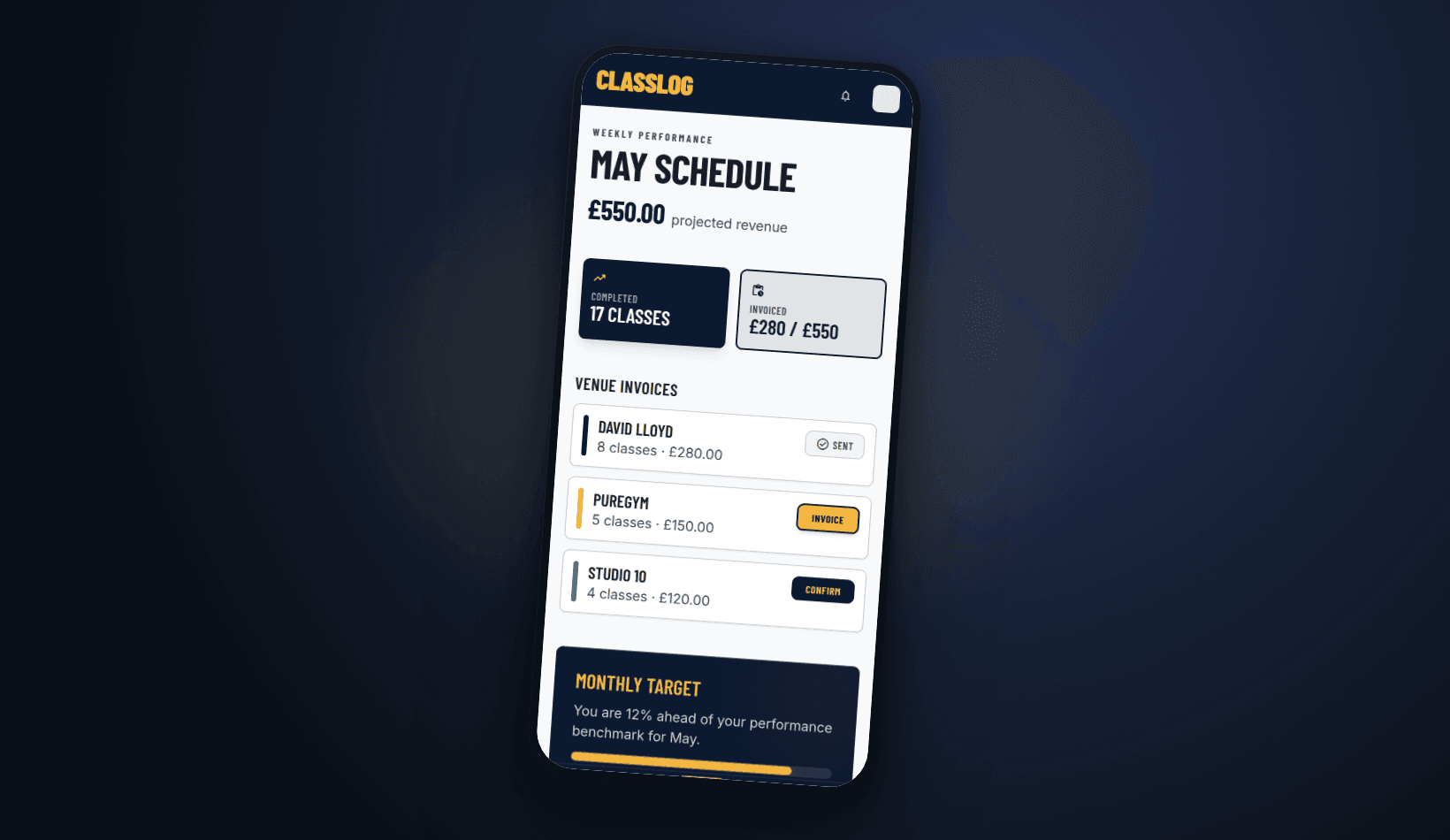
ClassLog is the operating system for that instructor — a single place to run the schedule, the money and the paperwork. Intelligent scheduling handles the calendar with 15-minute precision, a recurrence engine for regular classes, and a cover toggle that separates one-off cover from regular sessions. Pay and invoicing sits on top: per-venue rates, a live month-end revenue projection, one-click invoice generation, and self-bill document support for tax returns even when a venue pays automatically. A document vault stores insurance and certificates with proactive 30-day expiry alerts and one-click sharing when onboarding to a new venue.
Crucially, it's designed to keep instructors ahead of the legislation they don't have time to follow. HMRC's Making Tax Digital for Income Tax is arriving in stages, with the threshold dropping from £50k to £30k to £20k by 2028 — which will pull most full-time instructors into scope, requiring digital records kept through the year and filed with compatible software. These are small business owners, not accountants; almost none of them are tracking it. By building toward Xero and QuickBooks integration, ClassLog turns "just log your classes" into MTD-ready records as a byproduct — compliance that happens quietly in the background instead of a panic every January. It's built mobile-first for decisions made on the gym floor, with a robust desktop view for the month-end admin, under a design system I called "Elite Performance" — Midnight Navy, Barlow Condensed headers, and a single confident accent — carried from a written PRD through interactive prototypes to a pitch deck.
.story
Story
I taught group fitness classes, so this was a problem I lived. Every month I did what every freelance instructor does — reconstructed what I'd taught from my calendar and a stack of WhatsApp groups, did the maths by hand, and built different invoices in different formats for different venues. I'm a product manager. I decided to treat my own annoyance as a product.
I started with the problem, not the interface. I wanted to know whether my experience was structural or just my own poor organisation, and the research was unambiguous. A 2024 survey of UK group-exercise instructors found 24% manage up to seven separate WhatsApp groups for their schedule, and more than half avoid taking time off because arranging cover is too stressful. The nearest competitor — Striive, which had positioned itself almost exactly here — had already built, shipped and shut down. That told me two things at once: the niche is real, and the go-to-market is hard. So I wrote it up properly — a PRD with a sharp thesis ("eliminate the freelance friction"), personas, the three problem pillars, and functional requirements down to 15-minute grid snapping and self-bill document generation — before I drew a single screen.
The strategic angle I kept coming back to was Making Tax Digital. It's easy to pitch a tool like this as a convenience — save an instructor a few hours a month — but the more defensible wedge is legislation. MTD for Income Tax is being phased in on falling thresholds, and a full-time instructor teaching across several venues is squarely in scope by 2028. The catch is that these are small business owners who don't understand the rules and won't engage with them until they're penalised for missing them. A tool that quietly keeps their records HMRC-ready — because they were logging their classes anyway — stops being a nice-to-have and becomes the thing that keeps them out of trouble. That reframes the whole product: not "an admin app," but "how you stay compliant without having to think about it."
The decision I'm most deliberate about is terminology, and it sits on the roadmap as a real risk. "Self-bill" is the legally correct term for how most of these venue arrangements work, but instructors don't understand it, and getting it wrong erodes trust in a product that touches their tax. Rather than assume, I scoped it as something to A/B test — "Self-Bill" against plainer language like "Automated Payments" — because in a money product the words are part of the UX. The second call was form factor: this is a tool used in two completely different modes, so I designed it mobile-first for the poolside and the gym floor, and gave it a genuine desktop view for the month-end admin session, rather than stretching one to cover both.
The part I'd point to as the real work is the design system. The first cut leaned on a high-energy electric lime, and it cheapened a product that's fundamentally about someone's money and livelihood — it read like an energy drink, not a tool you'd trust with your tax. So I evolved the palette: kept the Midnight Navy core and the athletic Barlow Condensed typography, but moved the accent to a warm gold, which still reads "Elite Performance" (podium, gold standard) while feeling premium and trustworthy rather than loud. It's a small change that does a lot of work, and it's exactly the kind of judgement that separates a prototype that demos well from a product people would actually pay for.
ClassLog is a concept, and I'm honest about that. It exists as a full PRD, a design system, interactive prototypes, and a pitch deck — Phase 1. The next milestone is an MVP with a cohort of instructors to stress-test the scheduling and billing logic against real, messy schedules. I built it to prove a specific thing: that I can take a genuine problem I understood from the inside and carry it end to end — research, requirements, design system, prototype, story — into something you could put in front of a room and fund.
Every problem worth solving has a human at the centre of it.